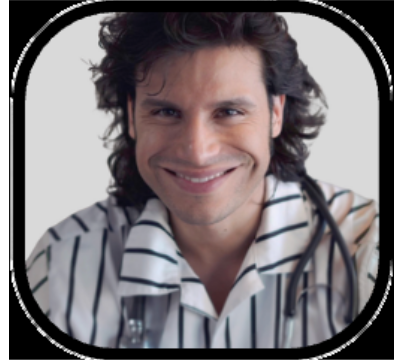
Personal faith. Clinical priority.
No one arrives at the end of life with a blank slate. We arrive with history, with belief, with doubt, with memory. That makes it clinical information. That makes it sacred ground.
— Waldo, NP
Evidence Base
Unmet spiritual needs don’t stay spiritual. They show up in pain scores. They show up in emergency calls at 2am. They show up in ICU beds. This is precision medicine for the dying.
The majority of seriously ill patients report that spirituality is important to them and want it acknowledged by their care team — yet few receive formal spiritual screening.
Patients with high spiritual support from their medical team were three times more likely to choose comfort-focused care over aggressive intervention near death.
Spiritual pain — the suffering that arises from loss of meaning, purpose, and connection — is reported by nearly half of hospice patients and often exceeds physical pain in intensity.
Patients who received high levels of pastoral and spiritual support had significantly lower rates of ICU admission in the final week of life, reducing both suffering and cost.
The National Consensus Project for Quality Palliative Care identifies spiritual, religious, and existential aspects of care as one of eight essential domains — not optional, not supplemental.
Accredited hospitals are required to assess the patient's spiritual orientation and cultural background as part of the initial care assessment — making this a regulatory, not just ethical, obligation.
World Religions at End of Life
I built this from the peer-reviewed literature — evidence-based analyses of how faith traditions approach death and dying. It's a general guide, not a complete one. A page like this could go on forever. I hope it gives you enough to show up informed, ask good questions, and follow the patient's rhythm. Start here. Then ask.
⚠️ Clinical reminder: No two patients practice their faith identically. Use these guides to open conversations, not close them. Always ask: "Is there anything about your faith or beliefs that is important to us knowing as we care for you?"
I've sat with patients who all called themselves Christian and needed completely different things. One needed a priest and a rosary. One needed her pastor and her worship music. One needed silence and her King James Bible and nobody else in the room. "Christian" is a starting point. Start there and then ask.
Burial within 24 hours. Body faces Mecca. Same-gender care preferred. Ritual washing by family. Ask about pork and alcohol in medications.
Do not leave the body alone. Burial as soon as possible. Shabbat affects scheduling. Orthodox and Reform patients may need completely different things.
A calm, clear mind at death matters deeply. Don't offer beef. Sacred items at the bedside are not decoration. Cremation is the norm, led by family.
Peaceful mind at death is the clinical goal. Minimize sedation if possible. Body may need to remain undisturbed for hours after death. Ask the family.
Never cut the hair. Never remove the steel bracelet. These are sacred articles of faith, not accessories. Ask about diet — many are vegetarian.
There is no single "Native American" tradition. Ask the patient. Ask the family. Historical trauma shapes every healthcare encounter. Start with humility.
Non-religious does not mean non-spiritual. Meaning, legacy, and relationships are the clinical anchors. Don't skip the spiritual assessment.
Blood refusal is a protected, informed decision — not a preference. Document early. Explore bloodless alternatives proactively. Do not attempt to persuade.
Temple garments are sacred — ask before removing. Family relationships are eternal theology, not metaphor. That belief is a source of profound comfort.
This is the fastest-growing group. Their beliefs are real, personal, and clinically relevant. Don't assume "no religion" means "no spiritual needs."
Ancestors are active and present. Spiritual leaders may need bedside access. Dual religious identity (e.g., Catholic and Santería) is common and not contradictory.
Chosen family may be the primary relationship. Verify legal documents early. Past discrimination shapes trust. Ensure chaplaincy is affirming before you refer.
Clinical content compiled from peer-reviewed literature. All citations link to original sources via DOI. Evidence retrieved via PubMed. Terminal2 · terminal2.org
Clinical Tools
Nobody wants to be handed a form about their soul. These work because they give you a place to start — not because they give the patient a box to check. Each one of these is just a clinician's way of saying: this matters to us. Use them in your own words. That's the whole point.
Developed by Christina Puchalski, MD at George Washington University. The most widely used spiritual history tool in palliative care training. Takes 2–5 minutes in conversation.
Developed by Anandarajah & Hight (2001). Uses inclusive, non-denominational language — excellent for secular and religiously diverse patients. Explores hope as an existential concept.
Developed by Maugans (1996). The most comprehensive of the three tools — suitable for structured intake or chaplaincy documentation when a thorough spiritual assessment is indicated.
Clinical Differential
These two conditions overlap significantly in presentation and are routinely conflated — resulting in patients receiving an SSRI when what they need is a chaplain, a conversation, and witnessed presence. Getting the differential right is clinical precision, not philosophy.
Select all that apply — the tool will suggest a direction
| Feature | Spiritual Pain | Depression |
|---|---|---|
▶Core complaint |
"My life has no meaning." "I don't know why I'm here." "I don't want to be a burden." | Persistent sadness, hopelessness, anhedonia — often unrelated to existential context |
▶Temporal quality |
Fluctuates; may improve with meaningful conversation, ritual, or connection | Persistent, pervasive; does not lift with meaning-making experiences |
▶Response to presence |
Visibly improves with compassionate witnessing, chaplain visit, family time | Limited response to interpersonal intervention alone |
▶Neurovegetative signs |
Often absent or attributable to physical illness | Sleep disruption, appetite change, psychomotor retardation beyond illness |
▶Hope structure |
May retain hope for meaning, relationship, or legacy even without future orientation | Global hopelessness — no future, no meaning, no relief anticipated |
▶Identity |
"I used to know who I was." Loss of role, relationship, or religious connection | Pervasive worthlessness, self-blame, guilt beyond circumstance |
▶Primary intervention |
Chaplain, Dignity Therapy, meaning-centered psychotherapy, ritual, witnessed presence | Psychiatric consult, antidepressants (short-acting preferred at EOL), psychotherapy |
| Can coexist? | YES — frequently. Screen for both. Treat both. They are not mutually exclusive. | |
| Refer to | When you see this | Clinical note |
|---|---|---|
| Chaplain | Loss of meaning, spiritual estrangement, unfinished relational business, desire for ritual, existential distress | Always the first referral. Do not wait for psychiatry to clear the patient first. |
| Psychiatry | PHQ-9 ≥10, neurovegetative symptoms, persistent anhedonia, suicidal ideation beyond EOL context, history of MDD | May run concurrently with chaplain referral — not instead of it. |
| Both | Mixed presentation; spiritual pain not resolving with chaplaincy alone; patient with both existential and neurovegetative features | Ideal interdisciplinary model. Chaplain and psychiatry should communicate directly. |
| Social Work | Spiritual pain driven by relational estrangement, family conflict, caregiver burden, or unresolved practical stressors | Often the missing piece. Social pain and spiritual pain present identically at the bedside. |
This section is an evidence-informed clinical synthesis. References below ground the differential, screening questions, and intervention recommendations.
Breitbart W, et al. (2000) — Spiritual well-being & desire for hastened death
Spiritual well-being was the strongest predictor of desire for hastened death in terminally ill patients — stronger than pain, stronger than depression. Unaddressed spiritual pain is not a soft outcome.
Chochinov HM, et al. (2011) — Dignity Therapy RCT
Dignity Therapy significantly improved spiritual well-being, reduced suffering, and enhanced sense of purpose and meaning in terminally ill patients compared to standard palliative care alone.
Breitbart W, et al. (2010) — Meaning-Centered Psychotherapy
An 8-session meaning-centered intervention significantly improved spiritual well-being and quality of life in advanced cancer patients versus supportive group therapy. Now validated in individual format.
Thekkumpurath P, et al. (2011) — PHQ-9 in palliative care
PHQ-9 is valid and feasible in palliative settings. A single-question screen has sensitivity of 55–74% — useful but not sufficient. Formal assessment warranted when score ≥10.
Bedside Protocol
Patients can't always tell you what they need. But sometimes they already have — by what's in the room. Stay observant. Notice what people place around themselves, around their loved one, around the bed. Those choices are telling you something.
| Object / Practice | Tradition | Significance | Clinical Protocol |
|---|---|---|---|
| Rosary |
Catholic Christianity | Meditative prayer beads; often held continuously by the dying patient | Do not remove; route IV lines and monitoring leads around it; document its presence |
| Crucifix / Cross | Christianity | Symbol of salvation; often hung on wall or placed near bedside | Do not remove from room or reposition without asking; consider it part of the patient's environment |
| Sacred Thread (Janeu) | Hinduism | Thread tied at initiation; marks caste and spiritual status; worn by men | Never cut or remove; route monitoring cables around it; document with nursing notes |
| Tulsi Mala (beads) | Hinduism | Holy basil beads representing Vishnu; worn for protection and devotion | Do not remove; treat as sacred; may be worn under gown |
| Ganga Jal | Hinduism | Holy water from the Ganges River; placed on lips or in mouth at death | Family may wish to administer at time of death; support this if patient can swallow or is unconscious |
| Kara (steel bracelet) Do not remove | Sikhism | One of the Five Ks; represents God's eternity and the Sikh's devotion; worn always | Never remove without explicit permission; notify surgeon/anesthesia early if procedure planned |
| Kesh (uncut hair) | Sikhism | One of the Five Ks; hair is given by God and must not be cut | Never cut Sikh hair — even in emergencies, seek family permission and document reasoning |
| Kirpan (ceremonial dagger) | Sikhism | One of the Five Ks; a symbol of justice and readiness to defend truth; not a weapon | Many jurisdictions protect the right to wear it; consult administration; never confiscate without legal basis |
| Medicine Bundle Do not touch | Indigenous traditions | Sacred collection of objects with spiritual power specific to the individual; may not be described or opened | Do not touch, open, or ask about contents; secure storage in patient's room; document its presence |
| Eagle Feathers Do not touch | Many Indigenous traditions | Sacred in many nations; spiritually significant and legally protected under the Eagle Protection Act | Do not handle, move, or discard; consult with patient or family for any movement required |
| Tefillin / Mezuzah | Judaism (Orthodox) | Prayer boxes worn during morning prayer (tefillin); mezuzah may be placed on door | Do not remove; accommodate morning prayer time; mezuzah on door is a family choice to be respected |
| Prayer Beads (Tasbih / Misbaha) | Islam | Used for dhikr — remembrance of God; 99 or 33 beads recounting God's names | Do not remove; patient may be in continuous prayer; preserve access during care |
| Quran | Islam | The word of God — must not be placed on the floor or near impure items | Handle only with clean hands or gloves; never place on floor or under other objects; elevate if necessary |
| Smudge Materials | Indigenous traditions | Sage, cedar, sweetgrass, or tobacco burned for spiritual cleansing and prayer | Work with facility fire safety to accommodate; open window, use fan, or coordinate timing; do not prohibit without alternative |
| Buddha Image / Altar | Buddhism | Focus for meditation and devotion; presence supports calm dying | Do not remove or reposition without asking; maintain clean, respectful environment around it |
Communication Guide
What you say in a person's room matters. These guides aren't about getting the words perfect. They're about staying present and authentic.
An authentic presence for family makes you a witness of the real movie that just finished.
— Waldo, NP
Interdisciplinary Team
Most clinical teams underutilize chaplains — not because they don't value spiritual care, but because they don't know what chaplains actually do or how to write a referral that gets used. This changes that.
A Board Certified Chaplain (BCC) through ACPE, NACC, APC, or NAPHCC holds a graduate theological degree, 1,600+ hours of clinical pastoral education, and passes national certification. This is a clinical credential — equivalent in rigor to other allied health certifications.
The National Consensus Project, Medicare Conditions of Participation for Hospice, and Joint Commission standards all identify chaplains as core members of the interdisciplinary team. A chaplain consult is a clinical order, not a courtesy call.
Patients who received chaplaincy services reported significantly higher quality of life, higher satisfaction with care, and lower rates of depression and spiritual distress at end of life compared to those who did not.
Most chaplain referrals say: "Patient is religious, please provide support." That is almost useless. Here's what to write instead:
Include: tradition, specific concerns, what family has asked for, what you've already tried, what you need chaplain to address specifically.
Trauma-Informed Care
Not every patient arrives at end of life at peace with faith. For some, religion was a source of real harm. Don't assume faith is safe ground just because you're standing on it. It can reopen wounds that have never fully closed. This is not uncommon. It is something to be ready for — best approached with studied familiarity and improvisational flexibility.
— Waldo, NP
Prevalence context: A 2022 study in Psychological Medicine found that 26% of adults who grew up religious reported at least one harmful religious experience. Clergy abuse survivors, those shunned from religious communities (Jehovah's Witnesses, Amish, Orthodox Jewish communities), and former members of high-control religious groups are all populations regularly present in end-of-life care. Do not assume faith is a comfort.
Post-Death Care
The moments after death are sacred in every tradition. What happens in those first minutes and hours can support or undermine a family's ability to grieve and heal. It can make or break the experience.
Communication Guide
The words land a little differently in that room than anywhere else. They don't need you to have the right thing to say. They need you to not say the wrong thing. This is the difference.
Printable Resources
Formatted for clinical use, family sharing, and interdisciplinary team education. All resources are peer-reviewed and evidence-informed.
I didn't go to seminary. I learned it at bedsides and by observing.
— Waldo, NP