Eating well on the road. Burnout prevention. Meditative rest.
Evidence-BasedSection 01 — Nutrition
The goal isn't perfect eating — it's strategic eating. Protein keeps your blood sugar stable and your empathy intact. Sugar crashes you in the middle of a grieving family's living room. I've been there. Here's how I avoid it.
You cannot take care of other people if you do not take care of yourself.
Section 02 — Waldo's Picks
What to order — and what to skip — at the places you actually pass between visits

Bodybuilders have been eating here for years (although quality has changed over time) — Double protein, no chips.

I prefer it over Chipotle. The ingredient quality is a step above — real hummus, real tzatziki, grilled proteins that taste like they were actually seasoned. When I want something lighter but equally clean, this is where I go.

It seems like I'm the only one that noticed that their grilled chicken for lunch changed several years ago. Now I only go to Chick-fil-A for breakfast. It's a better non-mesquite flavored chicken breast.

Organic salad bar (at least they say), antibiotic-free meats (I mean I haven't tested the meat or anything but) —

Big portions, a little too bready but better than other options. Nothing flashy — just okay.

The Unwich — any sub wrapped in lettuce instead of bread — turns a sandwich into a high-protein, low-glycemic lunch.

When I can find one between visits, I go out of my way for it. Build a bowl with whatever's fresh — it beats almost everything else on this list nutritionally. Takes five extra minutes. Worth it.

In my opinion better than Smoothie King. Peanut Paradise, double whey scoop, and get a chia oatmeal banana bowl.

Hey, when you're running behind, the grilled chicken and super greens will work.

A Texas gem that most may not think of as a lunch stop. Gourmet market-style hot bar with fresh-made proteins, real vegetable sides, and nothing that came out of a freezer bag. If you're in DFW, this should be a regular stop. Turkey plate, with veggies, roasted chicken, etc.

Clean grilled proteins, good macro profile, and nothing that leaves you bloated. Feels like a real meal.

It's the place to get a fajita/chicken lunch size and pre-order so you can eat on the road.

Better than it sounds, especially before an early first visit when I need something fast. The egg white options are available as soon as they open.

Regional, but genuinely excellent for morning visits. The egg bowls are clean. Unfortunately they closed one close to me.

I'm Hispanic. My mother's food is #1. But if I'm on the road looking for some homestyle something, go here.
Section 03 — Supplements
Daily support and immune defense — two separate lists, one place
These are good ones to consider. Talk to your own provider before starting anything new — you already know that.
Supplements fill gaps — they do not replace foundations. Sleep, hydration, real food, and consistent exercise are the base. Fix the basics first. And always consult your healthcare provider before starting new supplements, especially if you are on medications.
Section 04 — Restoration
Rest is not a reward for finishing your work. It is a prerequisite for doing the work well.
Hypocrite alert. Hypocrite alert. There is a kind of clinician who hadn't taken a real break in more than 12 years. Whose phone buzzes left and right. I know this clinician. I was this clinician. And the families we see at the end of life would tell us if they could to take care of yourself too.
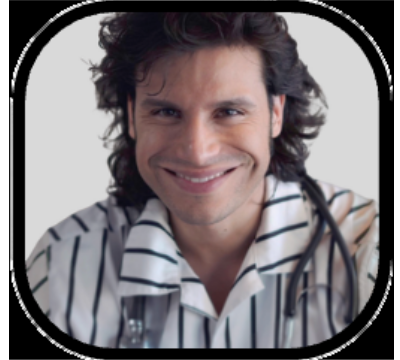
— Waldo, NP
Your prefrontal cortex, which governs empathy, clinical judgment, and emotional regulation, requires recovery time the same way muscle tissue requires rest between training sessions. The research on vacation, time off, and nature exposure is not soft — it is neuroscience.
Full disconnection for a minimum of 3 consecutive days is needed before the nervous system begins true recovery. A weekend does not count. Book it. Block the calendar. Tell your team. Do it before the year ends, not after.
Research shows that the recovery benefits of vacation peak at around day 8 and begin to decline within 2–4 weeks of returning. This means taking one long vacation is less effective than taking regular, shorter breaks throughout the year.
A systematic review and meta-analysis of 22 studies found that salivary cortisol levels were significantly lower in forest-exposed groups compared with urban control groups (p < 0.01).3 Japanese research on "forest bathing" shows 20 minutes in a natural setting measurably lowers cortisol, blood pressure, and inflammatory markers.
You do not need a trail. A park bench counts. A tree in a parking lot counts. Leave your phone in the car.
Sleep deprivation at 18–19 hours of wakefulness produces impairment equivalent to a 0.05% BAC. You would never assess a patient in that state. Do not drive or chart in it either.
Sleep is when your brain consolidates clinical learning, processes emotional encounters, and clears metabolic waste products (glymphatic system). Skipping sleep is borrowing from tomorrow's clinical judgment to fund tonight's charting. The interest rate is brutal.
Section 05 — Mindfulness
Hospice clinicians are exposed to death, grief, and suffering. Without a consistent internal practice, this exposure can accumulate. Meditation is the most evidence-supported tool for reducing secondary traumatic stress, restoring attentional capacity, and regulating cortisol.
It is not about emptying your mind. It is about deliberately training your attention.
Section 06 — EQ
Each family system has its own history, language, wound patterns, and communication norms. Emotional intelligence is the clinical skill that makes every other skill work. It is not a personality trait — it is a trainable capacity.
I have walked into homes where the family wanted clinical precision and data. I have walked into homes where they needed me to sit down, hold the wife's hand, and say nothing for two minutes. Reading the room — and adapting your entire communication register in real time — is the most sophisticated thing we do. Train it like a skill, not a gift.
— Waldo, NP
Know your emotional baseline before you walk in. You came from a difficult visit. You are running late. You are hungry. These states show up in your body language, your voice, your patience. Name them first.
Feeling something is not the same as acting on it. A family member's displaced anger belongs to them — you receive it without absorbing it. This requires practice, not just willpower.
Sympathy puts you across from the family. Empathy puts you with them. Sympathy says "at least." Empathy says "I am here with you in this." Hospice families know the difference instantly.
Read the room in the first 90 seconds. Is this family expressive or contained? Information-driven or relationship-driven? Religious or secular? Optimize your language, posture, and pacing to match — not to perform, but to connect.
Match their vocabulary. If they call it "passing," use passing. If they say "dying," meet them there. If they are formal, be formal. This is not inauthenticity — it is respect expressed through language.
Family conflict at end-of-life is not random — it is old pain surfacing under pressure. You do not adjudicate it. Redirect to the patient's comfort, and hold the container.
Most clinicians are trained to fill silence. In hospice, silence is often the most therapeutic intervention available. Sit with it. The family will fill it when they are ready.
"Help me understand how your family thinks about this" is always a safe entry point.
EQ in Practice: Rapid Field Tips
Section 07 — Energy Management
Hospice work is relentlessly interpersonal. It demands social presence, attunement, and emotional output at every visit. Understanding whether you are primarily drained or energized by social interaction is not a personality quiz — it is triage for your daily recovery strategy.
Personally, I want to go home at the end of the day. I have always been this way. I do not want a team dinner. I want quiet, my own space, and to not have to attune to another person for a few hours.
I usually eat alone. Not antisocially — strategically.
I say no to optional social obligations during heavy caseload weeks. This is not rudeness. This is self-preservation.
After a difficult death or a family conversation that took everything I had, I build in ten to fifteen minutes before I call anyone or check my messages. Not because I am avoiding anything — because I need to close the loop on what just happened before I open another one.
Even putting this on social media brings out the introvert heebie jibbies. But I am doing it because it is worth sharing the knowledge — right?
— Waldo, NP
Introverts burn out through overstimulation and insufficient solitude. Extroverts burn out through disconnection and emotional isolation. Neither type is more resilient — they simply need different inputs. Know which you are, and build your week accordingly.
Section 08 — Digital Health
The phone is not the problem. The relationship with it is.
The phone is the bridge between two worlds. Be intentional about which world you are in.
— Waldo, NP
A randomized controlled trial of healthcare workers found that an intervention to reduce work-related screen time during a weekend off doubled the reduction of stress levels compared to the control group — and the effect was most pronounced in those who uninstalled work apps from personal devices.6
Section 09 — Prevention & Recovery
Burnout is a physiological and psychological state produced by chronic, unmitigated workplace stress — and hospice work is among the highest-risk environments in healthcare. The WHO formally recognized burnout as an occupational phenomenon in 2019.7
Burnout in hospice clinicians is directly associated with: reduced empathy, clinical errors, documentation failures, patient safety events, higher staff turnover, relationship dissolution, substance use, and — at its most severe — suicide. These are documented outcomes in the peer-reviewed literature. Your burnout has downstream effects on every person in your care.
Signs by Domain
Prevention Framework
Section 10 — Growth
A 2025 study of older adults found that hobby engagement reduced the risk of belonging to a "persistently low cognitive function" trajectory by 54% (OR = 0.46).9 A separate study of 93,000 people found that those with hobbies reported better health, more happiness, fewer depression symptoms, and higher life satisfaction.10
You need something in your life that has nothing to do with hospice. Something that uses a different part of your brain.
The best hobby is the one you actually do. It does not need to be Instagram-worthy. It needs to occupy your hands or your mind in a way that is completely unrelated to clinical work.
The point is not mastery. The point is neural diversity — giving your brain pathways that are not saturated with grief, documentation, and clinical decision-making.
The most interesting clinicians I have worked with are the ones who know things outside of medicine. They can talk about architecture, or the Civil War, or how engines work, philosophy, chemistry, or why certain music principles sound the way they do.
It is about building a mind that is flexible, curious, and resilient. Cognitive diversity protects against the tunnel vision that comes from spending hours in the same emotional landscape.
A well-balanced clinician exercises four cognitive domains regularly, not just the clinical one:
If your entire week is spent in only one of these domains, your mind narrows. Balance across all four is what keeps you cognitively resilient, emotionally available, and professionally sustainable.
Section 11 — Resources
Printable guides for the whole clinician
References